
Ashburn City Directory Holdings
Ashburn is an unincorporated Loudoun County place, so historical directory research needs a wider shelf than the place name alone suggests. Thomas Balch Library documents local census, maps, deeds, wills, tax rolls, newspapers, family files, cemetery material, and vital indexes. Its public collection descriptions confirm the research tools, but they do not publish a complete title-by-title run of Ashburn, Leesburg, or Loudoun annual volumes. Treat a catalog result as the first step, not proof that a particular edition contains a household.
| Collection or lead | Documented period | Keeper | Best access route |
|---|---|---|---|
| Virginia landowners directory and gazetteer | 1815 data | FamilySearch catalog | County-arranged catalog record; not a residence directory |
| Loudoun deed and will indexes | Deeds 1757 to present; many local microfilm documents through 1904 | Thomas Balch and the Circuit Clerk | Published indexes, onsite microfilm, clerk records |
| Loudoun vital indexes | Births and deaths 1853–1896; marriages 1757–1935 | Thomas Balch | Print or microfilm index, then the proper record custodian |
| Federal census | Loudoun 1810–1930 | Thomas Balch | Onsite microfilm and subscription resources |
| Polk, telephone, and reverse directories | Exact local run not verified | Centennial Catalog and related catalogs | Confirm the title, edition, and access before relying on it |
Search the catalog with “Loudoun directory,” “Leesburg directory,” “Polk,” “telephone directory,” “criss-cross,” “reverse directory,” “Ashburn,” and a known community or street name. The absence of a listed annual run is meaningful: no specific publisher or year range should be assumed until the physical volume or catalog record is confirmed. Note: An index points to material; the page, film frame, or archival folder remains the evidence to cite.
Ashburn City Directory Desk
Thomas Balch Library is the local starting point for Ashburn directory work. Its non-circulating research collection is open to visitors at 208 West Market Street in Leesburg, and the library’s published phone number is 703-737-7195. The Centennial Catalog can be searched remotely, but the catalog does not search external databases. Many newspaper runs are on microfilm. Older and newer material outside that microfilm may be archival material requested through a Collection Request process and viewed at the reference desk.
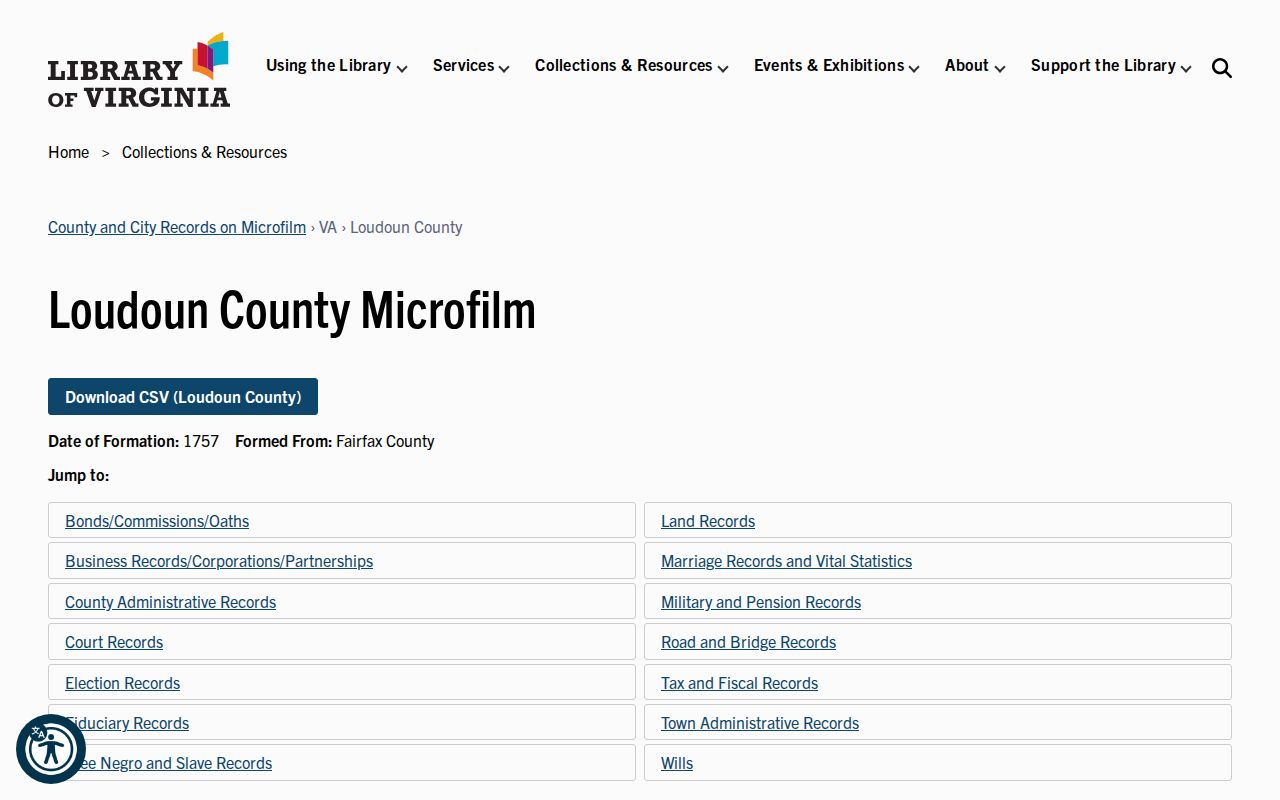
The Library of Virginia Loudoun microfilm catalog is the state-level companion. It identifies Loudoun court, election, fiduciary, land, marriage, and tax material. Use it when a Thomas Balch search identifies a record group but the desired roll, book, or county series is not on the local shelf. A reference request should name the person or place, approximate period, record category, and any known book, page, PIN, or deed reference. Staff can help locate materials, while legal conclusions remain the researcher’s task.
The Library of Virginia catalog entry shows the Loudoun microfilm categories available for historical record work.
For a hard-to-place Ashburn surname, compare the catalog description with the local library catalog before requesting a roll or box. That avoids treating a broad county collection as an annual volume.
Ashburn City Directory Land Clues
Two historical companions help when a name is older than a modern directory. The 1815 directory of Virginia landowners and gazetteer includes Loudoun in its Northern Region counties. Its catalog description identifies personal and place information, with land location and mileage or direction from the 1815 courthouse. It is a landowner reference, not evidence that someone occupied a home, but it can turn a surname into a geographic lead.
The 1854 Yardley Taylor cadastral map offers another bridge between people, land, and roads. It names some Loudoun residents and landowners. Match an old place name or road to a deed description, tax map, subdivision plat, or later census context before calling it the same present-day address. A PIN and legal description may persist longer than a postal street label, yet neither should be projected backward without that documentary chain.
These sources work especially well for a family-history question such as whether a named landowner, a census household, and a later deed belong to the same local line. They do not establish a current household or a precise modern location on their own.
Reading Ashburn City Directory Entries
No scanned local R.L. Polk page was inspected in the source research, so there is no verified Ashburn sample entry to reproduce. When a confirmed local volume is in hand, capture the fields below exactly as printed. This inventory keeps a later transcription tied to the edition rather than turning normal directory conventions into claims about every Loudoun volume.
| Printed name | Record the surname, initials, suffix, and any alternate spelling exactly. |
|---|---|
| Street or place | Copy the address, farm, village, post office, or business location as printed. |
| Relationship clue | Preserve any spouse, widow, boarding, or household notation only if the volume prints it. |
| Work or business line | Transcribe it as a historical clue, not proof of a present connection. |
| Edition citation | Keep title, publisher, year, page, and the abbreviation key with the entry. |
- Criss-cross directory
- An address-ordered section that can connect a confirmed street to a printed listing when the local volume includes one.
- Householder index
- An index organized around the person or household named in a collection, not a guarantee of every person present.
- Abbreviation key
- The volume’s explanation of shortened labels; photograph or transcribe it before interpreting an entry.
Ashburn City Directory Timeline
The reliable timeline is about the records, not an unverified printed-directory run. Loudoun separated from Fairfax in 1757, and county court records begin that year. Thomas Balch holds Loudoun census material from 1810 through 1930. The Library of Virginia supported conservation and digitization of Loudoun land-tax, will, deed, and criminal-paper series in 2022. The research did not establish a first or final local printed edition.
- 1757: Loudoun County begins its court-record history after separation from Fairfax.
- 1810–1930: Thomas Balch holds Loudoun federal census microfilm.
- 1815: The Virginia landowners directory supplies a county-based land clue.
- 2022: State-supported conservation and digitization work included several Loudoun historic series.
That long record span is useful because a directory gap can be filled with deeds, tax material, census, or an obituary index instead of guesses. The 2001 courthouse-complex fire is a provenance note, not a reason to assume historic court records disappeared; county history says those records survived.
Tracing Ashburn City Directories
Trace a household by moving from a confirmed entry to a second, independent record. Begin with every spelling of the name, then search the relevant catalog and inspect the actual page or frame. If a confirmed local reverse directory exists, work from the house number and street. Record the title, publisher, edition year, page, street spelling, abbreviation key, and whether the listing is residential or business. Search nearby streets and business listings because a person can be listed under a spouse or an organization.
- Find the first confirmed local listing or cataloged record for the name or place.
- Copy the source details and compare its address or place name with a deed, tax, or map clue.
- Check the next available edition without assuming an annual volume exists.
- Use an obituary, cemetery entry, probate file, or vital index to test a family connection.
- Keep an unresolved name separate from a confirmed household until another source connects them.
For a modern identity question, a directory find needs a separate current record check. The Ashburn resident lookup uses the appropriate official indexes without treating an old directory line as proof of present residence.
Ashburn Census Pairing
Pair a directory year with the surrounding census rather than reading either as a continuous roll. A directory may supply a name, address, place, or business clue between census dates. A census can add household relationships, ages, birthplace, and a decennial location. For older Ashburn research, the same household may be indexed under Loudoun, Fairfax, a rural district, a farm, a village, or a nearby post office.
Read the census image with neighboring households, road landmarks, landowner names, and the enumeration district. Then compare the result with a deed or tax record, which identifies an owner, and with the local newspaper or cemetery index, which can help establish family context. Note: A missing schedule or blank directory result does not prove a family was absent from the area.
Ashburn City Directory Access Limits
Thomas Balch materials are non-circulating, and archive items can require a collection request and reference-desk review. The library can be searched remotely, visited in person, or contacted for focused reference help. The county Clerk’s historic records offer a different route for deeds, wills, marriage material, chancery, judgments, and other papers: online PDF indexes, courthouse terminals, remote land-record access, and counter, mail, or email copy requests each serve different records.
Thomas Balch does not send its own research materials to other institutions, although interlibrary loan can bring outside material to the library. For an older Loudoun birth, death, or marriage lead, compare the local index with the appropriate Virginia custodian before ordering a record. A focused call or reference request can confirm whether a named item is onsite, on microfilm, or in an archive box.
Use a historical volume or index for family history, local history, and estate research. Do not turn a historical listing into a claim about a living person, and do not use records to pursue, harass, or harm anyone.